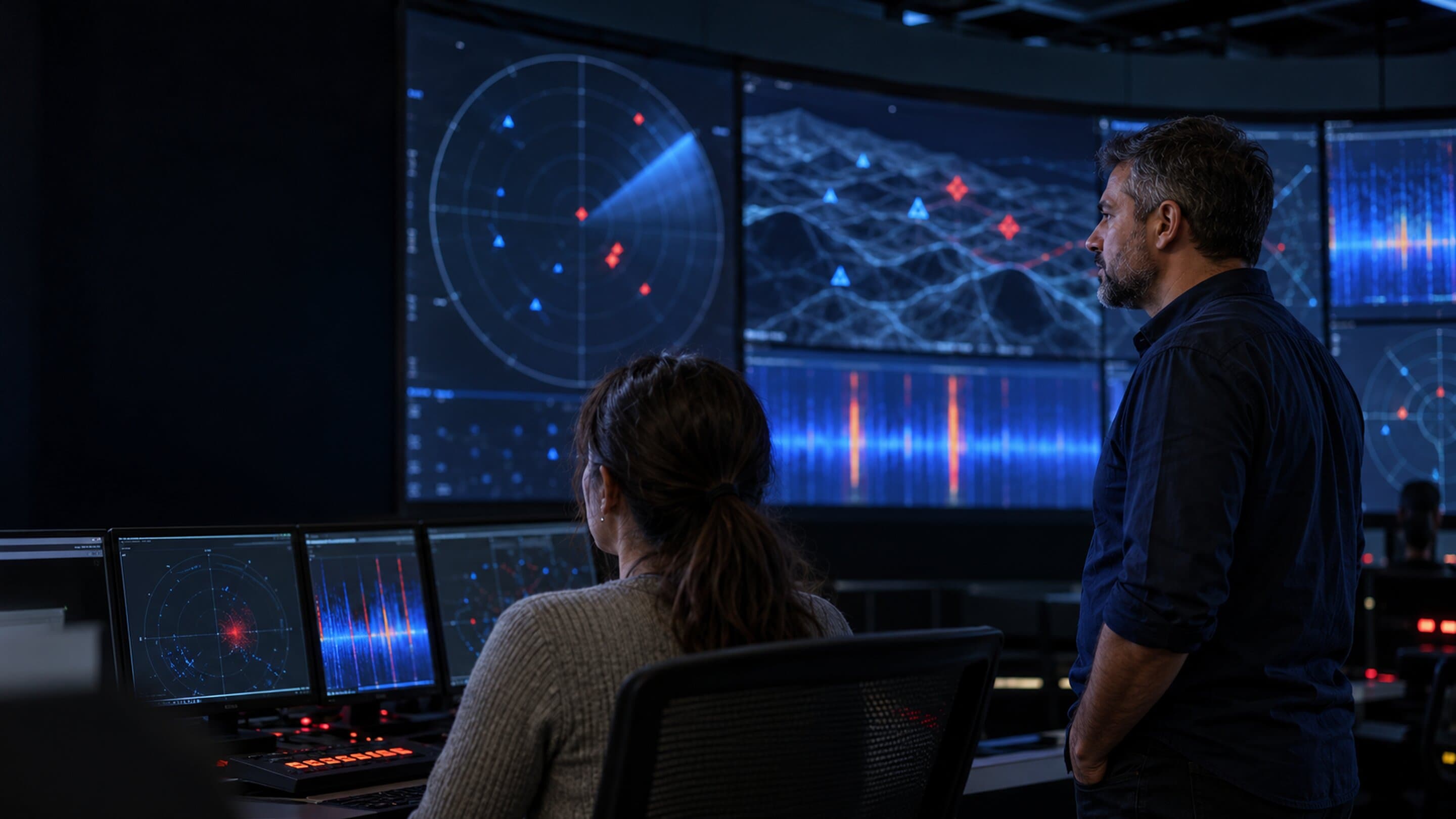
Train Joint Electronic Warfare Simulation
JETSIM
It takes electronic warfare training from the classroom to the field. Planners and decision-makers test what they have learnt in scenarios involving land, sea and air forces in an environment that closely resembles real operational conditions.
JETSIM is a Joint Electronic Warfare Training and Simulation Centre solution developed by MilSOFT; through the integration of the web-based e-learning application JETS and the interactive scenario application JETSIM, it transforms theoretical knowledge into practical skills.
- IEEE 1516 HLA and IEEE 1278 DIS Compliant
- Land, Sea, Air and Joint Training
How It Works
From concept to practical competence: four steps
Illustrative flow - 01 / 04
The concepts and applications of electronic warfare are covered via the web-based JETS platform, which combines academic knowledge with practical experience.
The scenario that the trainee will test in the context of the army, navy or air force is designed and previewed using the Scenario Editor; simulation assets are defined from a Reference Model Library.
Trainees practise in JETSIM, either against the computer or against other trainees in a Blue/Red team format, using 2D/3D visualisation and verbal/written communication.
Through After Action Review, trainee assessment and reporting, the conceptual framework is tested in a realistic operational environment and transformed into reinforced competence.
Problem
The problem is not a lack of theoretical knowledge; it is the inability to test this knowledge in a realistic setting
The concepts of electronic warfare learnt in the classroom cannot be sufficiently reinforced without a training environment that reflects real operational conditions. Trainees learn the concepts, but without a practical exercise, they have no opportunity to test how to apply this knowledge at the moment of decision.
The problem does not end there: electronic warfare is not the domain of a single service, but a field where land, sea and air elements must be coordinated simultaneously. Ensuring this joint coordination through regular physical exercises is logistically challenging and costly — as exercises become less frequent, the practical skills gained, along with the theory learnt in the classroom, become outdated.
This need is not new; however, as the threat environment has become increasingly multi-faceted, planners and decision-makers need to practise with more frequent and realistic scenarios — the physical exercise schedule cannot accommodate this frequency.
Developer / Educational Content Team
Without a practice environment, they cannot measure how well the theoretical curriculum they prepared is retained.
Systems Architect / Training Planner
Devising a scenario that encompasses land, sea and air elements simultaneously entails a far more complex planning burden than coordinating separate physical exercises.
Operations / Instructor team
Conducting physical exercises at regular intervals is logistically challenging and costly; this disrupts the continuity of training.
Organisation
Joint electronic warfare capability remains at the level of theory learnt in the classroom without regular practice.
Concepts are learnt in the classroom; skills are acquired in the field. The gap between the two is bridged not by physical drills, but by a repeatable environment.
Solution
Operational superiority is achieved not in the heat of battle, but during the preparation phase
The solution lies in combining theoretical training with practical application on a single platform. Trainees first learn the conceptual framework, then test this knowledge in an interactive scenario-based environment — either against the computer or in a head-to-head format.
It does not replace physical training; rather, it provides a practical environment that can be repeated with a frequency and regularity that physical training cannot offer.
Product
What is JETSIM?
JETSIM is the product that brings to life the model described in the Solution: it is a Joint Electronic Warfare Training and Simulator System, developed by MilSOFT, which provides planners and decision-makers in the land, naval and air forces with theoretical and practical electronic warfare training.
It is not a single application: it is a complementary dual-structure comprising a web-based e-learning application (JETS) that covers electronic warfare concepts and applications, and a simulation application (JETSIM) that puts this knowledge into practice within an interactive scenario environment. The simulation component is compliant with the IEEE 1516 HLA (High-Level Architecture) standard and supports both force-based and joint training.
JETSIM is not a general-purpose e-learning platform; it is a training and simulator system that brings together theoretical and practical electronic warfare training on a single, joint platform covering the army, navy and air force
Capabilities
Theoretical Training Infrastructure (JETS)
It offers comprehensive web-based content on the concepts and applications of electronic warfare; it combines academic knowledge with the field experience of electronic warfare officers.
Goal: To provide course participants with both the conceptual framework and a practical perspective from a single source.
Scenario Creation and Management
The Scenario Editor is used to create and preview scenarios; simulation assets are defined, stored and managed via a Reference Models Library.
Goal: To design reusable scenarios tailored to every training need.
Interactive, Multi-dimensional Simulation Environment
The training is conducted using 2D and 3D visualisations based on scenarios involving the trainee against a computer or between Blue and Red forces; formatted and free-text messaging, as well as voice communication, are included in the scenario.
Goal: To develop the trainee’s decision-making and implementation skills in an environment that closely resembles real operational conditions.
Assessment, Reporting and After Action Review
It provides trainee assessment, reporting and After Action Review capabilities.
Goal: To transform education from a one-off exercise into a measurable and revisitable process of development.
Standards-Based, Shared Scope
It complies with the IEEE 1516 HLA (High-Level Architecture) standard; it supports both service-specific and joint training for land, naval and air forces, as well as joint operations.
Goal: To establish the training infrastructure not on the basis of a single force, but in accordance with an open standard and joint operations.
Scalable Access to Training
The same training system is used not only extensively within the Turkish Armed Forces but also for electronic warfare courses for officers from allied countries.
Goal: To expand training capacity without the constraints of physical exercises.
The Difference
Why JETSIM?
What should be taken into account in joint electronic warfare training?
There are two common limitations in electronic warfare training: the lack of a realistic environment in which to put theoretical knowledge into practice, and the logistical challenges involved in regularly conducting coordinated training at the joint force level through physical exercises. JETSIM addresses both of these limitations on a single platform.
It combines theory and practice on a single platform.
JETS’s conceptual framework is tested directly within JETSIM’s scenario environment; there is no need to switch between separate systems.
It is based on an open standard.
Compliance with IEEE 1516 HLA ensures that there is no dependence on a single supplier’s proprietary simulation architecture.
It has been designed at the joint force level.
It brings together land, sea and air elements within the same training framework; it supports both force-based and joint training.
It is independent of the constraints of physical exercises.
Training designed using the Scenario Editor can be repeated without the logistical and financial burden associated with regular physical exercises.
The training concludes with a debriefing and reporting session.
Replay, evaluation and post-operation review capabilities transform practice into a measurable development process.
It is an educational model open to collaboration with partners.
Electronic warfare training is also provided to officers from allied countries via the same system.
Use Cases
Land, Naval, Air and Joint Training Programmes
It is used in the electronic warfare training programmes of the land, naval and air forces, at both force-level and joint levels, to enhance the theoretical and practical knowledge of planners and decision-makers.
Scenario-Based Exercise and Assessment
Scenarios involving computer-simulated opponents or Blue/Red force formats, together with debriefing and After Action Review, are used as a repeatable exercise and evaluation environment. War-game scenarios and exercise support are also available.
Developing Electronic Warfare Capabilities at an Organisational Level
More than 2,000 electronic warfare officers within the Turkish Armed Forces have been trained using this system.
Allied Nation Cooperation Training Courses
MilSOFT also provides electronic warfare courses for officers from allied countries via the same training system.
Architecture
- Application architecture
- Two complementary applications: the web-based e-learning application JETS and the interactive scenario application JETSIM.
- Simulation architecture
- Compliant with IEEE 1516 HLA (High-Level Architecture).
- Scenario tools
- Scenario Editor (production and preview); Reference Model Library for simulation assets.
- Visualisation and communication
- 2D and 3D visualisation; formatted and free-text messaging; voice communication.
- Assessment
- Trainee assessment and reporting; After Action Review.
- Training format
- Against the computer or in a Blue/Red force format; force-based and joint training.
Who Is It For?
Decision-maker
The ability to maintain a continuous state of joint electronic warfare readiness without relying on physical exercises.
Systems Architect / Training Planner
The Scenario Editor and Reference Models Library enable the simulation of land, sea and air elements within a single scenario framework.
Developer / Educational Content Team
Bringing together academic knowledge and practical experience on a single platform for course participants.
Operations / Instructor team
Repeatable practice sessions against the computer or in a Blue/Red forces format; with the option of debriefing via replay.
Organisation
A single training system compliant with IEEE 1516 HLA, scaling from widespread use within the Turkish Armed Forces to training in allied countries.
Capability - Train
Related Solutions
 Train Tactical Data Link Simulator TDLSIM TDLSIM is a tactical data link simulator developed in Türkiye that simulates the Link 11, Link 16, Link 22 and JREAP protocols in a testing, analysis and training environment. Explore
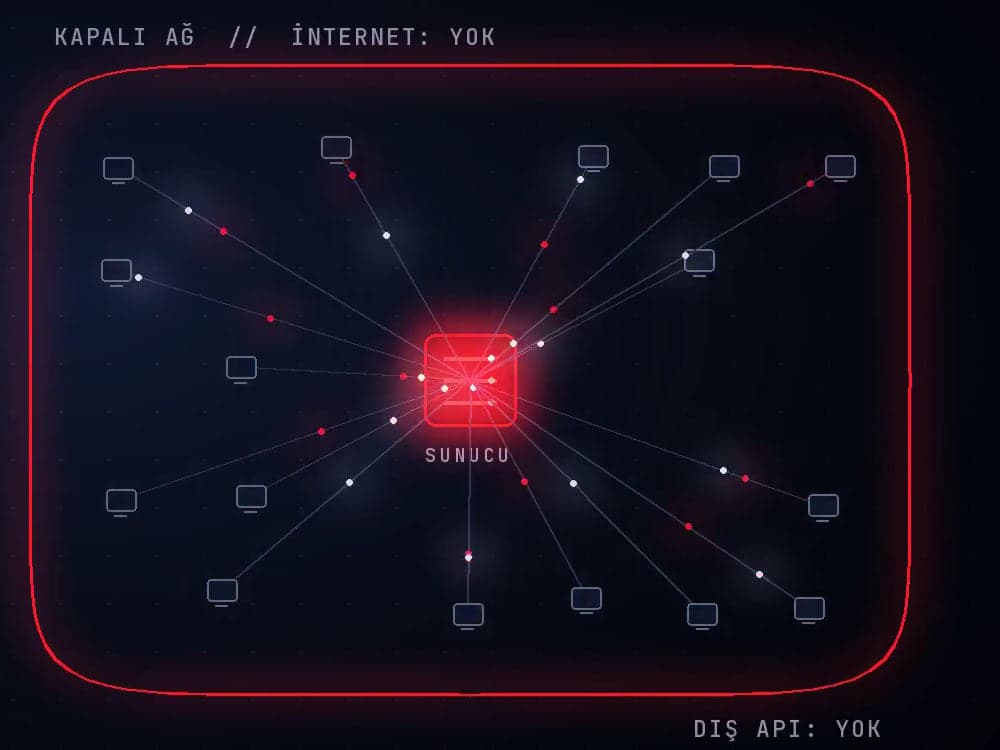 Augment In-House AI Assistant MilSOFT AI MilSOFT AI is an AI assistant that operates within your organisation’s infrastructure without requiring an internet connection; it supports Turkish in Office, PDF, desktop and web applications. Explore
 Sense Data Distribution Unit Mil-DDU Mil-DDU is a Data Distribution Unit (DDU) developed in Türkiye by MilSOFT, which centrally collects and processes data of varying structures from navigation, meteorological and communications systems, and distributes it in real time to the relevant platform subsystems. Explore
Related publication
Next Step
Electronic warfare should not be taught in the classroom, but tested in an environment as close to the field as possible
JETSIM combines theoretical and practical electronic warfare training for the army, navy and air force on a single, integrated platform.
There are three ways to evaluate JETSIM for your own training programme:
- 01 Training programme information pack Summary of the JETS/JETSIM scope and curriculum.
- 02 On-site visit / demo session A live demonstration based on a specified scenario.
- 03 Pilot training period An assessment period with a limited group of trainees.