04 Command Combat Management System
Mil-CMS
From sensor to decision, from patrol boat to fleet headquarters. One system, all theatres of operations.
Mil-CMS is a field-proven command and control system, developed entirely in Türkiye, that integrates all manned and unmanned assets across the air, land and sea domains into a single tactical overview.
- CMMI Level 5
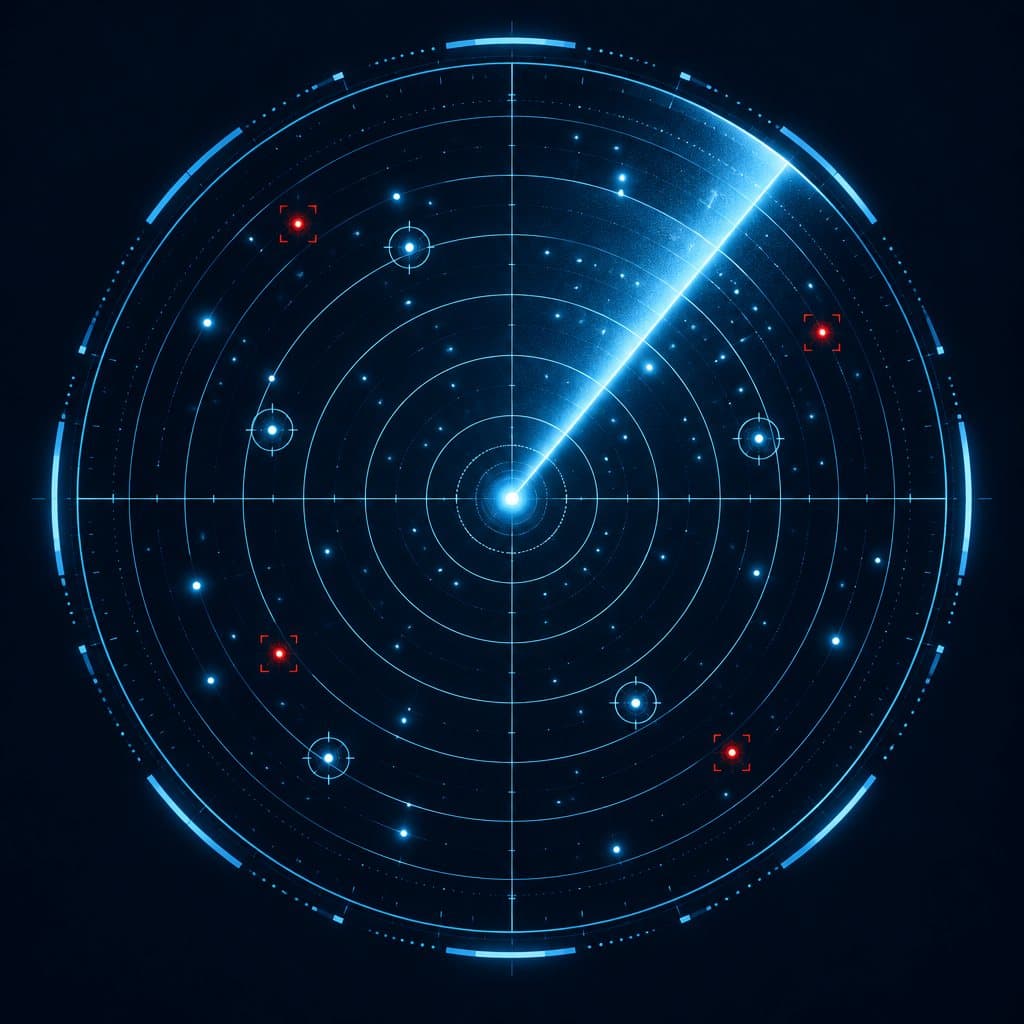
Common tactical picture – 7 tracks
Illustrative simulation
Toggle the sensors to see how the picture changes.
02Fusion & Tracking. Multi-sensor track fusion combines scattered detections; each contact becomes a single track on the common tactical picture.
How It Works
From sensor to firing decision: five steps
Illustrative flow - 01 / 05
Sensor data is collected from all platforms via Link 11, Link 16, Link 22, JREAP and VMF.
Raw data is processed using a multi-sensor fusion engine; track management, identification and correlation are carried out in real time.
Data from all domains is integrated into a 2D/3D Common Operational Picture (COP).
The TEWASA module prioritises threats and recommends appropriate weapon systems.
The firing decision is cancelled upon command authorisation; the weapon system is activated via Network-Enabled Weapon (NEW) control.
This order is no coincidence; it is the very essence of combat management
Problem
The problem is not that they cannot see the battlefield; it is that they cannot manage what they see in a timely and appropriate manner
In the modern battlefield, a platform generates data simultaneously from dozens of sensors. This data must be processed, classified and shared with the chain of command in real time. However, when data from different platforms and systems cannot be consolidated into a single, integrated picture, the chain of command is forced to make decisions based on delayed, incomplete and contradictory information.
A threat is identified but cannot be classified in time. A decision to open fire is made but coordination cannot be achieved. The weapon system is ready but cannot be directed at the correct target. As the platform grows, this disconnect deepens; a structure emerges that requires separate systems, separate screens and separate operators at every scale, from patrol boats to fleet headquarters.
Platform operator
It monitors sensor data on separate screens; there is no integrated tactical picture.
Tactical commander
Fire control decisions are delayed; the threat-weapon matching process is carried out manually.
Fleet commander
Coordination between platforms is fragmented; a common operational picture cannot be established.
Procurement officer
A separate system for each platform, separate integration costs and dependence on suppliers.
It is not enough simply to see the battlefield. You must manage what you see.
Solution
The process from sensor input to decision-making is carried out seamlessly within a single system
The solution is an integrated combat management architecture that consolidates all sensor and platform data into a single tactical display and carries out threat assessment and weapon assignment via the same system.
Decision-making superiority begins not on the battlefield, but on the tactical board
Product
What is Mil-CMS?
Mil-CMS is the product that brings the described architecture to life: it is a command and control system developed entirely in Türkiye by MilSOFT, which integrates manned and unmanned platforms across the air, land and sea domains into a single tactical display.
It is not merely a display interface. It is an integrated suite of capabilities ranging from sensor fusion to track management, from threat assessment to weapon assignment, and from tactical data link integration to unmanned system management. The same system operates from the OPCON level down to a tablet PC; the same architecture scales from a patrol boat to a large warship, and from a coastal station to a command centre.
It is based on an open architecture (OACE) and OMG DDS middleware. It integrates with existing sensor and weapon systems; it requires no changes from the outset.
Mil-CMS is not a general-purpose C2 visualisation tool. It is a combat management infrastructure that manages the entire battlefield.
Capabilities
Common Operational Picture
All assets in the air, land and sea domains are consolidated into a single 2D/3D table. Multi-sensor fusion, track management, identification and correlation are carried out in real time.
Goal: There are no missing, contradictory or delayed entries in the tactical table.
Threat Assessment and Weapons Allocation (TEWASA)
For every detected threat, automatic prioritisation, the assignment of the appropriate weapon system and the management of the fire decision cycle are carried out via a single module.
Goal: The time taken from the detection of a threat to the decision to open fire, as well as human errors, are reduced.
Tactical Data Link Integration
Support for messaging (MHS) in formats compatible with Link 11, Link 16, Link 22, JREAP, VMF and ADatP-3; interoperability with allied and coalition systems.
Goal: Sharing a common tactical picture with allied and coalition platforms via a single interface.
Unmanned Systems Management (UxV)
Telemetry processing, mission planning and execution, payload management, video streaming and image processing. Manned and unmanned assets are managed within the same tactical framework.
Goal: Unmanned systems do not require a separate console; they are a natural part of the tactical display.
Incremental Growth
It starts with weapons control and scales up to a full-fledged CMS. From OPCON to tablet PCs, from patrol boats to headquarters – it’s all part of the same system. Suitable for every budget and every platform size.
Goal: As the platform grows, so does the system; there is no need to make further purchases to gain new capabilities.
Open Architecture and Legacy Integration
Open architecture in accordance with the OACE standard; integration whilst preserving existing sensor and weapon systems. Requires no replacement from scratch; infrastructure investment is preserved.
Goal: Existing sensor and weapon systems are retained, and Mil-CMS is integrated into them.
The Difference
Why Mil-CMS?
How does Mil-CMS stand out from other CMS solutions?
In the defence sector, combat management systems typically come with three drawbacks: platform lock-in, customisation constraints and a lack of access to source code. The update schedule depends on the supplier’s priorities; adding a new capability requires a new contract. Mil-CMS offers the same capability under a different engineering and ownership model.
It ensures technological sovereignty.
Ownership of the source code; freedom to have maintenance carried out in Türkiye; the organisation determines the update schedule.
It is field-proven.
It is in operation in real combat environments on operational platforms.
It preserves legacy systems.
It integrates with existing sensor and weapon systems; there is no need to modify the infrastructure.
It grows incrementally.
It starts on a small platform, and the same system is transferred to the large platform; there is no need to buy it again.
It is a true multi-domain system.
Air, land, sea — manned and unmanned. A single picture, all domains.
Use Cases
Naval Platforms
Sensor-weapon integration and tactical display management on frigates, corvettes, patrol boats and SAR vessels.
Air Platforms
Mission management and tactical data link integration in patrol aircraft, helicopters and unmanned aerial vehicles.
Land Command Centres
Multi-platform management and a common operational picture in headquarters vehicles and command centres.
Coastal and Port Security
Command and coordination at OPCON level for the surveillance of coastal security and critical maritime infrastructure.
Technology and Standards
Architecture
- Middleware
- OMG DDS; open architecture (OACE); POSIX-based OS
- Hardware
- COTS; integration with legacy CMS; high redundancy
- Scalability
- From OPCON to tablet PCs; from weapon control to a fully-fledged CMS
- UxV
- Telemetry, mission planning, payload management, video streaming
Standards and Certifications
- CMMI Level 5
- Active
- TSE-ISO-EN 9000
- Active
- OMG C4I Task Force
- Compliant
- Link 11 / 16 / 22
- Supported
- JREAP & VMF
- Supported
- ADatP-3 / MHS
- Compliant
Who Is It For?
Procurement officer
An investment that grows gradually and fits within the budget, without reliance on a single supplier.
Systems Architect / Integrator
Open architecture; integration with existing infrastructure; no need to replace legacy systems.
Tactical commander
A single system from sensor to firing decision; automatic threat-weapon matching with TEWASA.
Fleet commander
A multi-platform, multi-domain shared operational picture; command coordination at OPCON level.
Organisation
Domestic development, ownership of source code, technological sovereignty.
Next Step
A single system for managing the battlefield
Mil-CMS is a combat management system developed entirely in Türkiye that integrates all assets across air, land and sea domains into a single tactical table, providing seamless management from sensor to fire decision. It scales from patrol boats to fleet headquarters using the same architecture and the same code base.
There are three ways to evaluate Mil-CMS within your own platform architecture:
- 01 Download the technical evaluation pack Product documentation, capability matrix and integration guide.
- 02 Request an architecture workshop A half-day joint assessment of your current platform architecture.
- 03 Book a demo A live system demonstration based on a real-life scenario.