
Protect Cross-Domain Security Solution
Mil-CDS
It controls the flow, not the boundary. It examines the flow of data between different security levels at the message level; it does not allow unauthorised data to pass through.
Mil-CDS is a Cross-Domain Security (CDS) solution certified to Common Criteria (CC) EAL4+, which enables secure and controlled data communication between networks with different security classification levels.
How It Works
Collect, check, clean, send: four steps
Illustrative flow - 01 / 04
The data flow intended to pass between networks with different security levels reaches the system.
A structural and semantic analysis is carried out at the message-level; the data is classified.
Content changes are implemented where necessary; measures against covert channels and intrusion detection are activated.
Only authorised, secure content passes through to the target network; the networks are unaware that this process is taking place.
Problem
The problem isn’t separating the networks; it’s not being able to see when and how much data passes between the separated networks
Networks with different classification levels—such as confidential, non-confidential and top secret—are generally kept physically separate from one another for security reasons. However, operational requirements occasionally necessitate the controlled transfer of data between these separate networks.
Carrying out this transfer using manual or loosely controlled methods carries the risk of unauthorised data leaks and covert channels; in particular, superficial checks on message content can lead to unauthorised data passing through to the lower-security side undetected.
This need is not new; however, as the volume of data shared in joint and allied operations increases, it becomes impossible to monitor every point of transit between the two networks through manual checks — and the organisation must be able to document this in its accreditation and procurement processes.
Developer / Integrator
For each new connection point, they are forced to set up a manual or loosely controlled transmission method; this method carries the risk of a new covert channel.
Systems architect
It is forced to re-evaluate the balance between physical separation and the need for operational data sharing for each connection.
Operations / ISSM-ISSO
It attempts to monitor the risk of data leaks and covert channels through a superficial check that does not examine the content of the messages.
Organisation
It carries the risk of unauthorised data passing through to the less secure side without being detected; it cannot document this risk in international procurement and accreditation processes.
Separating the networks does not solve the problem; the problem is who sees the traffic passing through, when, and how much
Solution
Security is not ensured at the border, but in the crossing itself
The solution is not to open up the networks to one another, but to exercise full control over the traffic passing between them. Full visibility is provided over the incoming and outgoing data flow; data is examined at the message-level, and only authorised content is allowed to pass through to the other side.
This control is implemented not on the network itself, but at the point of interconnection between the networks — without altering the existing topology or operational processes.
Product
What is Mil-CDS?
Mil-CDS is a Cross-Domain Security solution developed by MilSOFT and certified to Common Criteria EAL4+. It manages the flow of data between two or more security domains, providing full control over incoming and outgoing traffic.
It operates completely transparently, requiring virtually no configuration changes to the networks to which it is connected — the networks remain unaware of the system’s presence. Its intrusion detection and prevention capability operates in tandem with this transparent deployment model.
Mil-CDS is not a general-purpose firewall; it is a cross-domain security solution that controls the transition between different security levels at the message level
Capabilities
Certified Security Standard
It complies with the Common Criteria EAL4+ certification and TEMPEST requirements. As a result, it provides documentation rather than mere claims in international procurement and accreditation processes.
Message-Level Analysis and Classification
It carries out structural and semantic analysis of the data stream at the message field level, makes changes to the content where necessary, and classifies the data. In this way, it ensures a level of scrutiny that goes beyond the surface to examine the content of the messages.
Covert Channel and Intrusion Prevention
It takes measures against covert channels and detects and prevents intrusions. In this way, it prevents data leaks from occurring not only through obvious channels but also through indirect ones.
Flexible Filtering and Authentication
It enhances network segmentation with its flexible and advanced filtering capabilities; it operates on the basis of a well-defined capability model underpinned by robust authentication. This capability model clearly defines who can view what.
Transparent Deployment
It can be deployed on the networks to which it is connected with virtually no configuration changes required; it does not interfere with the existing network topology or operational processes. In this way, a layer of security is added without interrupting operational processes.
Scalable, Extensible Architecture
It features a scalable, distributed and modular architecture; it provides a fully extensible infrastructure that supports the addition of new protocols and message formats. This enables it to scale from a single security boundary to multiple endpoints whilst maintaining the same architecture.
The Difference
Why Mil-CDS?
What should one look for in a cross-domain security solution?
There are two common weaknesses in this area: superficial monitoring of message content allows unauthorised data to slip through undetected; whilst redesigning the network topology to prevent data leaks brings operational processes to a standstill. Mil-CDS is free from both of these weaknesses.
It is based on a certified standard.
CC EAL4+ and TEMPEST compliance emphasises documentation rather than mere claims.
It inspects down to the message content.
It does not merely perform superficial filtering, but carries out a structural and semantic analysis at the message-level.
It accounts for covert channels too.
It assumes that the leak may occur not only through direct channels but also through indirect ones.
It is deployed transparently.
It comes into operation without affecting the existing network topology or operational process.
It brings together a variety of protocols in one place.
It operates on the same security principles, from general corporate network traffic right through to tactical data links.
It scales as you grow.
It adapts from a single security boundary to multiple endpoints, using the same scalable architecture.
Use Cases
Headquarters – Field Data Bridge
In environments requiring secure data sharing between military networks with different security classifications, it is used as a data bridge between headquarters and field systems.
Interoperability with NATO and Allied Systems
Thanks to its support for tactical data link protocols such as Link 16 and JREAP-C, it is deployed in scenarios requiring interoperability with NATO and allied systems.
Critical Infrastructure and Multi-Scale Deployment
It provides cross-domain data control in projects requiring critical infrastructure security; thanks to its scalable and distributable architecture, it adapts to deployment scenarios of varying scales, ranging from a single security perimeter to multiple access points.
Security Certificate for International Procurement Processes
Thanks to its CC EAL4+ certification, it can also be presented as a security certificate in international procurement processes.
Technology and Standards
Architecture
- Certification
- Common Criteria EAL4+; compliance with TEMPEST requirements.
- Inspection model
- Structural and semantic analysis, content modification and data classification at the message field level.
- Authentication
- A well-defined capability model based on strong identity verification.
- Deployment
- Transparent; it does not interfere with the existing network topology or operational process.
- Architecture
- Scalable, distributable and modular; capable of being extended to accommodate new protocols and message formats.
Supported Protocols
- General corporate network traffic
- HTTP/S, Remote Desktop, FTP/S, VOIP
- Tactical data link
- Link 16, JREAP-C, ASTERIX, DIS
- Messaging and data format
- ADEXP, XML, J-CHAT, WMO
Who Is It For?
Decision-maker
The ability to meet security requirements in international procurement processes with CC EAL4+ certification.
Systems Architect / Integrator
The ability to commission the system transparently, without altering the existing network topology.
ISSM / ISSO
Significantly reduce the risk of data leaks through message-level analysis and countermeasures against covert channels.
Operations team
A system that requires virtually no configuration changes, ensuring that day-to-day operations are not disrupted.
Organisation
Long-term deployment flexibility thanks to interoperability with NATO and allied systems and a scalable architecture.
Capability - Protect
Related Solutions
 Train Tactical Data Link Simulator TDLSIM TDLSIM is a tactical data link simulator developed in Türkiye that simulates the Link 11, Link 16, Link 22 and JREAP protocols in a testing, analysis and training environment. Explore
 Train Joint Electronic Warfare Simulation JETSIM JETSIM is a scenario-based joint electronic warfare simulation platform for the army, navy and air force. Explore
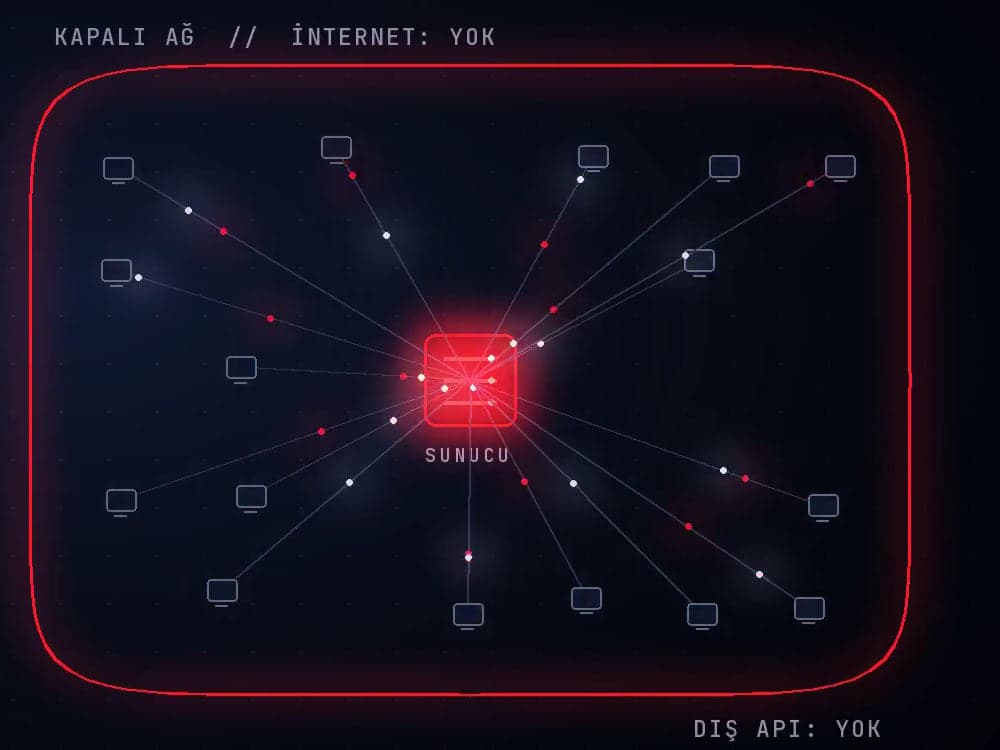 Augment In-House AI Assistant MilSOFT AI MilSOFT AI is an AI assistant that operates within your organisation’s infrastructure without requiring an internet connection; it supports Turkish in Office, PDF, desktop and web applications. Explore

Next Step
It controls the crossing, not the border
Mil-CDS monitors data passing between networks with different security levels at the message level, permitting only authorised content to pass through — using a security model certified to CC EAL4+, without altering the existing network topology.
There are three ways to evaluate Mil-CDS within your own network architecture:
- 01 Technical assessment package Product documentation, list of supported protocols and certification documents.
- 02 Architecture workshop A half-day joint assessment of your current network topology.
- 03 Proof of concept (PoC) A limited-scope deployment within a specified security boundary.